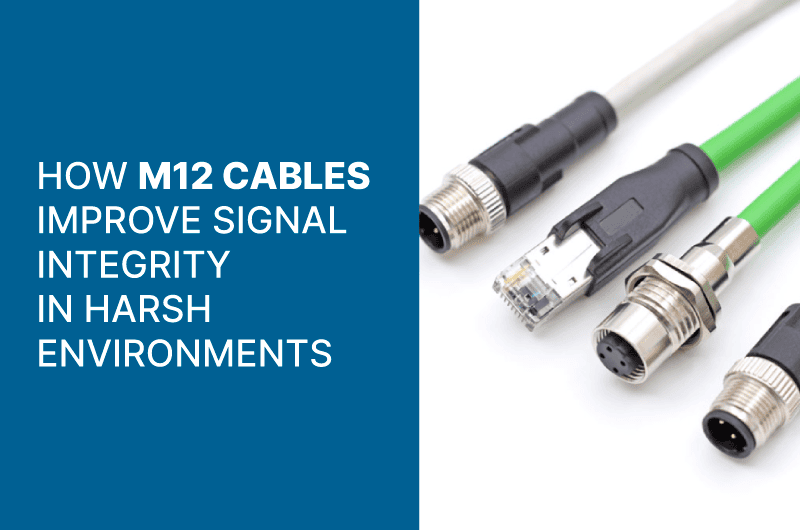
M12 cables are essential for maintaining signal integrity in harsh environments. Their robust design and quality materials allow them to perform reliably under extreme conditions, such as high temperatures, humidity, and vibrations. These cables play a critical role in industrial automation by ensuring reliable data transmission. The various configurations and shielding options available further enhance their effectiveness in challenging settings.
Evolution of M12 Cables
The evolution of M12 cables is a reflection of the advancements in industrial technology and connectivity needs. From their inception to modern applications, these cables have undergone significant changes to accommodate the demands of various automation settings.
Historical Development in Industrial Applications
Initially developed for the interconnection of sensors and actuators, M12 cables quickly became a staple in industrial settings. Their introduction coincided with a surge in industrial automation during the late 20th century. As manufacturing processes evolved, so did the complexity of the systems that required reliable data transmission.
In the early days, M12 connectors were primarily used in simple machinery applications. Over time, as automation became more sophisticated, the demand for robust and versatile cabling solutions grew. This led to the adoption of M12 cables across multiple sectors, including automotive production, food and beverage processing, and logistics.
Advances in Design and Materials
Modern M12 cables are designed with advanced materials that enhance their durability and performance. Today’s manufacturing processes utilize high-quality plastics and metals that provide improved resistance to environmental stresses. These innovations allow M12 cables to perform under extreme temperatures, humidity, and mechanical vibrations.
- Cable insulation has evolved to include various grades of thermoplastics, ensuring better resistance to chemicals and abrasion.
- Shielding techniques have advanced, with options for both unshielded and shielded cables to mitigate electromagnetic interference and maintain signal integrity.
- Connector designs have improved to ensure a tighter fit and enhanced durability against wear over time.
Adaptations for Modern Automation
As industries shift toward Industry 4.0 and smart manufacturing, M12 cables have adapted to meet new technological challenges. Their compatibility with various communication protocols such as PROFINET and EtherCAT enables seamless integration into complex network systems. This adaptability is crucial for real-time monitoring and control in automated environments.
M12 cables now support not only data transmission but also power delivery, simplifying the installation process and reducing the number of cables needed. This consolidation is particularly beneficial in environments where space is limited, ensuring a tidy and efficient wiring layout.
The ongoing development in M12 cable technology ensures that they remain relevant in the rapidly changing landscape of industrial applications. With continued advancements, M12 cables are poised to support the future of automation and connectivity in various sectors.
The Role of M12 Cables in Industrial Automation
M12 cables play a critical role in the seamless operation of industrial automation systems. Their robustness and reliability enhance the efficiency of various automated processes.
Essential Functions in Data Transfer
One of the primary roles of M12 cables is to facilitate data transfer between devices within an industrial network. Their design ensures secure and consistent connections, which is vital for maintaining high data integrity. Key functions include:
- Enabling real-time communication between sensors, actuators, and controllers.
- Providing high-speed data transmission rates, essential for modern automation systems.
- Minimizing latency, which improves the overall responsiveness of automated systems.
Supporting Automation and Control Systems
M12 cables are essential for supporting various automation and control systems. Their ability to withstand harsh environmental conditions makes them suitable for diverse applications in industrial settings. Major contributions include:
- Integrating with existing control architectures to enhance system performance.
- Providing reliable connections for automated machinery and robotics.
- Ensuring operational continuity in critical applications where failure is not an option.
Compatibility with Communication Protocols
M12 cables support multiple communication protocols that enable interoperability among various devices. This compatibility ensures that these cables are suitable for a wide range of applications. Important aspects include:
- Support for industrial protocols like PROFINET and EtherCAT, facilitating integration within complex networks.
- Utilization in IoT ecosystems, enabling data sharing and real-time monitoring.
- Enhancing the scalability of automation systems by allowing seamless device additions without compromising performance.
Signal Integrity and Environmental Challenges
Maintaining signal integrity in harsh environments is crucial for the reliable operation of industrial systems. Various environmental factors pose challenges that can impact data transmission. Understanding how M12 cables address these issues is essential for their effective application in industrial automation.
Mitigating Electromagnetic Interference (EMI)
Electromagnetic interference (EMI) can drastically reduce signal quality, causing data loss and miscommunication among connected devices. M12 cables are designed with specific features that mitigate these effects:
- Shielding: Many M12 cables are outfitted with robust shielding, which includes layers of conductive materials that prevent external electromagnetic fields from distorting the signal.
- Twisted Pair Design: The use of twisted pairs for conductors helps cancel out electromagnetic noise, enhancing the clarity of the transmitted signals.
- Proper Grounding: Effective grounding practices ensure that stray currents are dissipated, further protecting signal integrity.
Overcoming Radio Frequency Interference (RFI)
Radio frequency interference (RFI) is another significant challenge in industrial settings, particularly around equipment that operates in high-frequency ranges. M12 cables excel in minimizing RFI through:
- High-Frequency Handling: These cables are constructed to handle high-frequency signals, allowing them to maintain performance without degradation.
- Shielding Materials: Using advanced shielding techniques, including foil and braid configurations, provides robust protection against RFI.
- Connector Design: The design of M12 connectors contributes to a tighter fit and better shielding, which aids in minimizing interference.
Performance in Harsh Environmental Conditions
M12 cables are built to perform under extreme conditions such as high temperatures, humidity, and vibration. Key attributes include:
- Temperature Resilience: Many M12 cables can operate in a wide temperature range, ensuring reliable signal transmission even in extreme heat or cold.
- Moisture Resistance: Specially designed jackets protect against moisture and corrosion, making these cables ideal for environments with high humidity or where liquids may be present.
- Vibration Tolerance: The construction of M12 cables includes features that resist damage from vibrations, ensuring continuous connectivity during movement or operation.
The combination of these design elements ensures that M12 cables provide a dependable solution for maintaining signal integrity in various challenging industrial environments.
M12 Cable Construction and Design
The construction and design of M12 cables are critical to their performance, particularly in harsh operating conditions. These cables are engineered to provide robust connectivity and signal integrity, ensuring reliable operation across various applications.
Shielded vs. Unshielded Variants
M12 cables come in both shielded and unshielded variants, each serving distinct purposes based on environmental and application needs. Shielded cables are designed to minimize external interference, making them suitable for areas with high electromagnetic interference (EMI). They feature an additional layer of conductive material, such as foil or braided shields, which surrounds the internal wires.
- Shielded M12 cables are ideal for:
- Heavy industrial environments
- Locations with multiple electronic devices
- Applications requiring high data integrity
In contrast, unshielded M12 cables are more cost-effective and lightweight. They typically find use in less demanding applications where electromagnetic interference is minimal. Their simpler construction can offer better flexibility, although they may not support high data rates in challenging environments.
Heavy Duty Connector Features
M12 cables typically utilize connectors designed for rugged environments. These heavy-duty connectors feature a locking mechanism that ensures secure connections, preventing accidental disconnections during operation. Their durable construction is often made from materials such as stainless steel or high-grade plastics, providing resistance against corrosion, moisture, and abrasion.
- Key features of heavy-duty connectors include:
- IP67 or higher protection ratings
- Resistance to extreme temperatures
- Mechanical strength to withstand impacts
This robust design allows M12 connectors to perform reliably in harsh environmental conditions while ensuring efficient data transfer and power supply to connected devices.
Reliability in Shock and Vibration Environments
M12 cables are specifically designed to withstand the rigors of shock and vibration, making them suitable for demanding industrial applications. Their construction incorporates materials that absorb shock, helping to protect internal conductors from damage. This is particularly important in areas where equipment operates under constant vibration, such as manufacturing floors or transportation systems.
- Factors contributing to M12 cables’ reliability include:
- Flexible conductor materials that can endure movement
- Reinforced cable sheaths that prevent abrasion and tearing
- Quality control measures during manufacturing to ensure consistently high standards
The resilience of these cables not only enhances their longevity but also improves the overall effectiveness of the systems they are part of, ensuring uninterrupted performance and less downtime.
Integration of M12 Cables in Industry 4.0
The integration of M12 cables within the framework of Industry 4.0 enhances operational efficiency and connectivity. By adapting to advanced automation technologies, M12 cables contribute significantly to modern manufacturing environments.
Enhancing Connectivity in Smart Factories
Smart factories represent a pivotal shift in the manufacturing landscape, prioritizing automation and real-time data analytics. M12 cables play an essential role in establishing robust interconnections among various devices, including sensors, machines, and controllers. The rugged design and multi-functional capabilities of these cables ensure seamless communication across all components of the factory floor.
Key advantages of M12 cables in smart factory environments include:
- Durability: Engineered to withstand the challenging conditions commonly found in industrial settings.
- Flexibility: Available in multiple configurations to facilitate varied installation scenarios.
- Scalability: Easily adaptable to accommodate new devices and expansions in the network.
Enabling Real-Time Data Transmission
One of the cornerstones of Industry 4.0 is the capability for real-time data transmission, which enhances decision-making processes. M12 cables provide the necessary bandwidth and reliability to support high-speed communication between interconnected devices. This capability is particularly significant in applications that require instantaneous feedback, such as robotics and automated assembly lines.
M12 cables are designed to transmit data at speeds exceeding 100 Mbps, making them ideal for:
- Continuous monitoring: Ensures equipment operates at optimal levels by providing immediate alerts on performance status.
- Automation control: Facilitates coordinated functions across multiple devices to streamline production workflows.
- Data integrity: The robust construction of M12 cables helps maintain the purity and clarity of the transmitted data.
Applications in IoT and Smart Devices
The rise of the Internet of Things (IoT) in industrial applications necessitates reliable connectivity solutions. M12 cables support a variety of smart devices, allowing for seamless integration within IoT ecosystems. Their compatibility with protocols such as PROFINET and EtherCAT enables smooth communication across different network architectures.
Specific applications of M12 cables in IoT include:
- Sensor networks: Connecting a multitude of sensors to monitor environmental parameters and operational metrics.
- Remote monitoring: Facilitating connections for devices that relay data back to central management systems.
- Automation systems: Supporting the interconnectivity of devices that integrate AI and machine learning for improved efficiency.
Practical Applications of M12 Cables
M12 cables are essential in various industrial applications, providing reliable connections for both data transmission and power delivery. Their robust design makes them ideal for harsh environments. The following sections discuss their practical uses across different sectors and scenarios.
Usage in High-Speed Data Communication
M12 cables play a pivotal role in high-speed data communication within industrial machinery and automation systems. Their construction supports fast transfer rates, crucial for real-time data processing and monitoring. Various configurations of M12 cables, including shielded versions, help minimize data loss and interference, ensuring that signals remain clear and accurate.
Key benefits of using M12 cables for high-speed communication include:
- Support for speeds exceeding 100 Mbps.
- Compatibility with multiple communication protocols such as PROFINET and EtherCAT.
- Improved signal integrity in the presence of electromagnetic interference (EMI).
Power and Data Solutions for Equipment
M12 cables not only facilitate data communication but also provide power to various devices and sensors in an automation setup. The dual functionality of these cables simplifies wiring configurations, reducing clutter and associated installation costs. M12 Power cables are specifically designed to handle higher voltages and currents necessary for operating motors and actuators.
Practical considerations include:
- Streamlined power distribution within compact spaces.
- Reduced requirement for additional cabling, which enhances safety and reliability.
- Ease of integration into existing systems, thanks to standardized connector designs.
Case Studies in Various Sectors
The application of M12 cables spans a wide range of industries, showcasing their versatility and effectiveness. Several high-profile case studies illustrate their impact:
- Manufacturing: A large automotive manufacturer improved production efficiency by implementing M12 connections in robotic assembly lines, leading to enhanced communication between machinery and control systems.
- Telecommunications: A telecommunications company utilized M12 cables for reliable connections in outdoor equipment installations, ensuring uninterrupted data flow in various weather conditions.
- Energy Sector: In renewable energy installations, M12 cables provided robust connections between wind turbines and monitoring systems, optimizing energy output while minimizing signal loss.
These examples highlight the adaptability of M12 cables in meeting the demanding requirements of modern industrial environments.
Technical Specifications and Considerations
The technical specifications and considerations are essential for ensuring optimal performance in M12 cables, especially in demanding environments. Understanding the technical details helps engineers and technicians make informed decisions for installation and application.
Understanding Pin Configurations
M12 cables come with various pin configurations, which play a crucial role in their functionality. These configurations can range from 3 to 12 pins, depending on the application requirements.
- configurations are typically used for simple sensor connections.
- configurations are commonly found in actuators and basic signal transmission.
- and 12-pin configurations support advanced communications and power supply, allowing for more complex data transmission and device interactions.
Choosing the correct pin configuration is vital to establish the right connections and ensure signal integrity within industrial automation systems. The arrangement of pins also affects the compatibility with different devices and protocols, impacting overall system functionality.
Adapter and Connector Variants
Various adapter and connector variants are available for M12 cables, enabling flexibility and compatibility across different systems. These connectors are designed to facilitate seamless integration into existing infrastructure.
- Standard connectors offer a robust solution for reliable data communication.
- Heavy-duty connectors are built to withstand harsh environmental conditions, ensuring longevity and safety in industrial applications.
- Field-installable connectors allow for on-site adjustments, providing convenience during installation and maintenance.
The choice of adapter and connector can significantly influence the efficiency of M12 cables in transmitting data and power. Selecting the right variant contributes to minimizing signal loss and maintaining optimal performance.
Ensuring Compliance with Industry Standards
Compliance with industry standards is paramount when implementing M12 cables across various applications. Regulatory specifications ensure that cables operate effectively under defined conditions and facilitate interoperability between devices.
- Key standards such as IEC 61076-2-101 govern the technical requirements for M12 connectors, ensuring compatibility and performance.
- RoHS compliance is essential for reducing hazardous substances in cabling materials, contributing to safer industrial environments.
- Certifications like UL and CE validation provide assurance of quality and safety for cables used in critical applications.
Adhering to these standards not only enhances safety but also ensures that systems function reliably over time. As industries advance and new technologies emerge, staying updated with compliance requirements is crucial for maintaining high operational standards.
If you would like to receive a quote for any of custom cables or connectors, please do not hesitate to contact us by sending an email to sales@readytogocables.com or calling in the USA this phone number (682-325-1944).