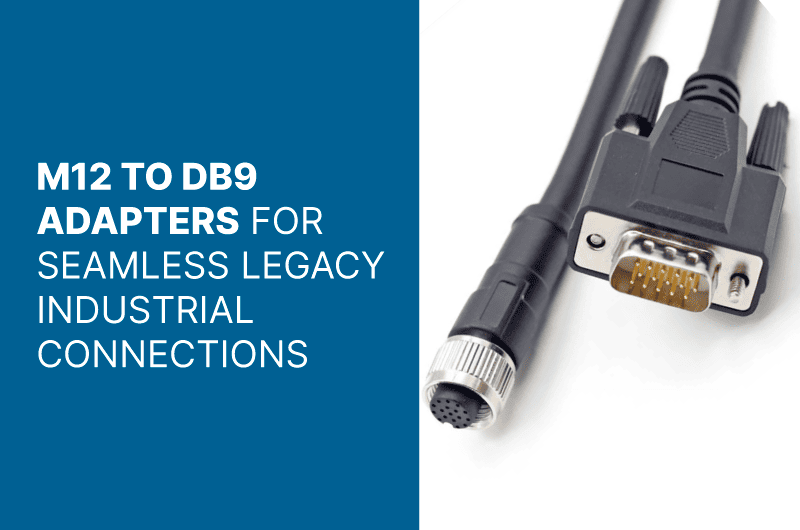
M12 to DB9 adapters are essential for bridging the gap between modern technology and legacy industrial connections. They facilitate seamless integration of older systems with newer devices, ensuring functionality in various industrial applications. These adapters play a crucial role in enhancing compatibility while offering cost-effective solutions. Their robust design and reliable performance make them vital for maintaining communication between diverse equipment in industrial environments.
Understanding M12 to DB9 Adapters
M12 to DB9 adapters serve a critical function in integrating diverse equipment within industrial environments. Their ability to connect various devices allows for smooth communication, ultimately enhancing operational efficiency.
The Role of M12 and DB9 Connectors
Both M12 and DB9 connectors play significant roles in industrial applications. M12 connectors are renowned for their robust and reliable design, making them ideal for challenging environments. They are commonly used in sensors and automation devices due to their ability to withstand harsh conditions, such as moisture, dust, and vibrations.
On the other hand, DB9 connectors, despite being an older technology, remain prevalent in many legacy systems. Their purpose revolves around serial communication, facilitating reliable data transmission through a nine-pin configuration. This continued usage in industrial settings underscores the importance of adapters that can bridge the gap between these two distinct connector standards.
Benefits of Using M12 to DB9 Adapters
Employing M12 to DB9 adapters brings various advantages to industrial applications. These benefits include enhanced compatibility with older systems and the provision of cost-effective solutions for companies looking to modernize their operations.
Enhancing Compatibility with Legacy Systems
As industries evolve towards modern technologies, the need for seamless integration of legacy systems becomes paramount. M12 to DB9 adapters enable older devices, such as legacy control systems and sensors, to interface effectively with new machinery. This transition allows facilities to maximize their existing investments by extending the lifespan of legacy equipment.
Moreover, these adapters promote interoperability, enabling data exchange between devices that operate under different communication protocols. This capability is essential in dynamic industrial environments where various equipment must work in tandem to achieve optimal performance.
Cost-Effective Solutions for Industrial Applications
Implementing M12 to DB9 adapters can significantly reduce the financial burden associated with completely overhauling an entire system. Retrofitting existing equipment with these adapters is not only a practical approach but also a strategic financial decision. Organizations can prolong the use of dependable legacy systems while gradually incorporating modern technologies.
Furthermore, the ease of installation ties into the cost-effectiveness of these adapters. They typically feature plug-and-play designs, allowing maintenance teams to make connections with minimal downtime and without extensive training. This ease of use translates into increased operational efficiency and a quicker return on investment.
In the realm of industrial connectivity, understanding the technical specifications and design aspects of M12 to DB9 adapters is essential. These components are engineered to meet the demanding requirements of various industrial environments.
Technical Specifications and Design
Robust Construction and Materials
The design of M12 to DB9 adapters emphasizes durability and resilience. Constructed from high-quality materials, these adapters are built to withstand harsh industrial conditions. The robust construction ensures that they can endure exposure to dust, moisture, and vibrations typical in manufacturing settings.
Common materials used in the manufacturing process include:
- Stainless steel housings for corrosion resistance.
- High-temperature thermoplastics to withstand elevated operational temperatures.
- Heavy-duty connectors that support reliable mechanical connections.
Signal Isolation and Stability
Effective data transmission hinges on signal integrity. M12 to DB9 adapters incorporate features that provide superior signal isolation, minimizing the risk of data corruption due to electrical interference. This is vital in environments where multiple devices operate simultaneously, as it ensures clear communication channels.
Stability in signal transmission contributes to:
- Reduction of noise interference.
- Enhanced data accuracy and clarity.
- Improved operational dependability across connected devices.
Compatibility with Industrial Devices
These adapters are designed with versatility in mind, making them compatible with a wide range of industrial devices. The M12 connector is renowned for its ability to accommodate various signals, whether digital or analog, ensuring seamless integration with legacy systems.
Connecting Various Serial Devices
Facilitating connections between different serial devices is one of the core functionalities of these adapters. They bridge the gap for devices such as sensors, controllers, and legacy equipment, allowing for consolidated control and monitoring solutions.
Ensuring Reliable Serial Port Communication
Reliable communication is imperative in industrial applications. M12 to DB9 adapters are engineered to support steady serial port communications, eliminating data loss and ensuring that information flows efficiently between devices. This reliability is crucial for time-sensitive applications where delays can lead to operational issues.
Real-World Applications of M12 to DB9 Adapters
The implementation of M12 to DB9 adapters is pivotal across various industrial applications. These connectors bridge the gap between modern and legacy systems, ensuring uninterrupted operation within diverse sectors.
Factory Automation Systems
In the realm of factory automation, seamless communication between machinery is essential. M12 to DB9 adapters play a significant role in connecting various components like machines and sensors, facilitating cohesive operations.
Integrating Sensors and Controllers
Integration of sensors and controllers is a primary application of these adapters. Sensors equipped with M12 connectors can transmit vital data to controllers that utilize DB9 interfaces. This integration allows for real-time monitoring and analysis, contributing to improved operational efficiency.
Process Control in Industrial Environments
Process control requires precise and reliable data transmission in industrial settings. M12 to DB9 adapters enable this by linking measurement devices with control systems, thus enhancing the accuracy of operations.
Monitoring Systems and Rapid Response
Utilizing M12 to DB9 adapters facilitates efficient monitoring of conditions in various processes. By connecting legacy monitoring systems with newer technology, industries can quickly respond to any fluctuations in parameters, ensuring safety and compliance.
Security Systems Integration
The integration of older security systems with current technology is increasingly necessary for maintenance and updates. M12 to DB9 adapters provide a simple solution to upgrade these setups while retaining existing equipment.
Bringing Legacy Security Equipment Up to Date
Legacy security systems often utilize DB9 connections. Adapting these systems with modern sensors and cameras that employ M12 connectors enhances surveillance capabilities while minimizing the need for complete equipment replacements. This approach preserves the investments made in older systems while benefiting from advancements in technology.
Environmental Monitoring Equipment
Environmental monitoring is critical for many industries, and the ability to connect advanced sensor technology with legacy systems is vital. M12 to DB9 adapters serve this purpose effectively, allowing for widespread data gathering and analysis.
Utilizing Advanced Sensor Technology
Advanced sensors can provide crucial data regarding air quality, temperature, and various environmental factors. By employing M12 to DB9 adapters, these modern sensors can interface seamlessly with traditional monitoring infrastructure, ensuring that critical environmental data is captured without interruption.
Advantages and Considerations
Understanding the benefits and considerations when using M12 to DB9 adapters can significantly impact industrial operations. These factors play a crucial role in ensuring efficient connections between legacy systems and modern technology.
Cost Savings and Flexibility in Implementation
One of the primary advantages of utilizing M12 to DB9 adapters is the financial benefit they offer. Investing in new equipment can be prohibitively expensive for many industries. In contrast, these adapters provide a practical solution to extend the life of existing infrastructure by marrying old and new technologies seamlessly. This approach not only preserves capital but also maximizes the return on investment.
The flexibility offered by these adapters plays a critical role in operational adaptability. Industries often face unique challenges that require tailored solutions. M12 to DB9 adapters allow for easy adjustments and modifications without the need for overhauls or significant alterations to existing systems. By enabling this kind of flexibility, companies can respond more effectively to changing demands.
Ease of Installation and Plug-and-Play Capability
Another significant advantage is the straightforward installation process associated with these adapters. Their plug-and-play capability means that operators can quickly set them up without extensive training or special tools. This user-friendly design can reduce installation time markedly, resulting in minimal disruption to ongoing operations.
The ability to connect devices effortlessly promotes smoother workflows in industrial settings. Rapid deployment is essential, particularly in environments where downtime can be costly. For this reason, ease of installation is a key factor that enhances operational efficiency.
Challenges in Protocol Compatibility and Interference
Despite the numerous benefits, certain challenges can arise when implementing M12 to DB9 adapters. One of the primary concerns involves protocol compatibility. Not every device that utilizes these connectors will necessarily communicate effectively. It is crucial to ensure that the protocols used by legacy systems align with the specifications of the modern devices attempting to connect.
Electrical interference represents another challenge that industries must address. In environments crowded with machinery and electronics, signal integrity can be compromised. This interference can disrupt communication and lead to data loss, ultimately impacting performance.
Addressing Electrical Interference Issues
To mitigate the risks associated with electrical interference, implementing robust shielding and isolation mechanisms is essential. These measures can protect signal quality, ensuring that data transmitted between devices remains reliable. It is important for industries to consider these factors during installation to minimize potential disruptions.
Future Trends in Industrial Connectivity
This section explores emerging trends shaping industrial connectivity, with a focus on advancements that enhance communication and streamline operations within industrial environments.
Shifts Towards Modern Connectivity Standards
The industrial sector is witnessing a significant transition towards contemporary connectivity standards. These newer protocols, such as Ethernet and wireless communication, offer improved speed and efficiency compared to traditional methods. Industries are increasingly adopting these technologies to facilitate faster data transfer and more reliable inter-device communication. Consequently, the integration of Ethernet-based solutions enables real-time data analysis and enhances automation capabilities.
Innovations in Adapter Design
As connectivity needs evolve, so do adapter designs. Manufacturers are focusing on creating more compact and efficient adapters that enhance performance while simplifying installation processes. Innovations include:
- Improved thermal management to enhance durability and performance
- Modular designs that allow for easy upgrades as technologies change
- Incorporation of advanced materials to withstand harsh industrial environments
Smart Monitoring and Diagnostic Capabilities
A key feature in the evolution of adapters is the integration of smart monitoring and diagnostic functions. These capabilities provide real-time insights into connection quality and operational status. By implementing technologies that can monitor signal strength and stability, manufacturers aim to mitigate potential issues before they impact system performance. This proactive approach enhances reliability and minimizes downtime, contributing to smoother operations.
Integrating Internet of Things (IoT) Technologies
The integration of IoT technologies is reshaping industrial connectivity. By enabling devices to communicate over the internet, organizations can collect and analyze data more effectively. This shift empowers industries to leverage big data for predictive maintenance and efficiency improvements. As a result, IoT-enabled adapters are being designed to support seamless integration with existing infrastructure, bridging the gap between legacy systems and modern digital solutions.
The future of industrial connectivity is paved with innovations that not only respond to immediate needs but also anticipate future challenges, ensuring a robust and adaptable infrastructure for industrial applications.
If you would like to receive a quote for any of custom cables or connectors, please do not hesitate to contact us by sending an email to sales@readytogocables.com or calling in the USA this phone number (682-325-1944).